
I’ll never forget that morning. I woke with what began as a scratchy tightening behind one eye. It was that peculiar moment when you know something is coming. Then the anticipatory discomfort arrived in all its glory. Everything seemed too loud, too sharp, and keeping both eyes open suddenly felt ambitious.
It was my first serious migraine. So what do you do? If you’ve had one, the answer is usually whatever is within reach, whatever has worked before, whatever somebody swears by, and perhaps a few things you would normally consider ridiculous. Pain makes experimentalists of us all.
You might reach for medication, caffeine, hydration, an ice pack, acupuncture, a dark room, or soft light of some particularly soothing wavelength. Wander far enough into migraine culture and the experiments become more creative. Some people swear by McDonald’s fries and a Coke—a combination of salt, carbohydrates, sugar, and caffeine delivered in one snack-tacular, scientifically questionable therapeutic package. Others eat a spoonful of yellow mustard, “Excuse me, do you have any Grey Poupon?” There is the hot-feet-and-cold-neck strategy: feet submerged in hot water while an ice pack sits on the back of the neck. Peppermint oil. Daith piercings. Even deliberately inducing brain freeze in the hope that one unpleasant neurological sensation might somehow interrupt another.
The evidence supporting some of these practices ranges from limited to nonexistent. But when half your head appears to be attempting to detach itself from the rest of your body, scientific dignity becomes negotiable remarkably quickly. Modern migraine sufferers have a large menu: neurologists, acupuncturists, aromatherapists, piercing studios, online forums, fast-food restaurants and, apparently, the condiment aisle. Which brings us to Cannabis.
People have been using cannabis for headaches for a very long time. What we have not had for nearly as long is the kind of evidence scientists generally want before concluding that a treatment works for a specific outcome in a specific type of headache: randomized, double-blind, placebo-controlled clinical trials.
For acute migraine, we now have one of those fancy clinical studies. Schuster and colleagues conducted a randomized, double-blind, placebo-controlled crossover trial of vaporized cannabis for acute migraine. The study is interesting not simply because cannabinoid-containing treatments outperformed placebo on several important outcomes, but because the investigators also captured part of the peculiar reality of migraine research: you have to wait for the migraine to happen.
Researchers cannot schedule one for Tuesday afternoon at 2:15 pm and tell everybody to report to the clinical research unit. You enroll people, train them, send them home with study materials, and wait for biology to cooperate. When an attack begins, the participant has to recognize it, determine whether it qualifies, and use the treatment within a specific set of conditions. That makes the study an interesting combination of laboratory control and real-world chaos.
The participant essentially has to identify the migraine and determine the appropriate window for—in less formal scientific terminology—sparking a fatty for clinical research.
The investigators enrolled 92 adults with migraine. Participants could treat up to four separate migraine attacks, receiving a different blinded treatment during each one: cannabis containing approximately 6% THC; approximately 11% CBD; approximately 6% THC plus 11% CBD; or placebo cannabis containing essentially neither cannabinoid.
There was a washout of at least one week between treated attacks. This is where one of the initially confusing numbers in the paper comes from. There were 92 participants but 247 treated migraine attacks. Those were not 247 different people. They were individual migraine episodes treated during the crossover study.
The crossover design is useful because migraine is variable. My migraine may behave differently from yours, and two migraines experienced by the same person may behave differently from one another. By having the same participant encounter several treatment conditions, each person can serve, at least partly, as their own control.
An eligible migraine had to be less than four hours from headache onset, the pain had to have reached moderate or severe intensity, characteristic symptoms such as photophobia, phonophobia or nausea had to be present, and the participant could not already have used another acute treatment.
If the attack qualified, the participant vaporized the study cannabis at 180°C using a Mighty Medic handheld vaporizer. Even the puffing was standardized: inhale for five seconds, hold for 10 seconds, exhale, wait 45 seconds, then repeat four times. It may not resemble the way most people use cannabis on a Saturday evening, but it makes for considerably better pharmacology.
Migraine studies force us to be precise about what improvement means. The primary endpoint was pain relief two hours after treatment. Pain relief does not necessarily mean the migraine disappeared; it meant moderate or severe pain had fallen to mild pain or no pain.
The investigators also examined the higher bar of pain freedom—the pain was gone—and freedom from the participant’s most bothersome symptom, such as nausea, photophobia or phonophobia. A treatment that turns a terrible migraine into a tolerable migraine may certainly be useful, but making the pain disappear altogether is a different outcome.
The THC-plus-CBD preparation produced the broadest pattern of benefit. At two hours, 67.2% of attacks treated with THC plus CBD achieved pain relief, compared with 46.6% with placebo. Complete pain freedom occurred in 34.5% versus 15.5%, while freedom from the most bothersome symptom occurred in 60.3% versus 34.5%. THC by itself also produced significantly more two-hour pain relief than placebo—68.9% versus 46.6%—but it did not significantly outperform placebo on complete pain freedom or freedom from the most bothersome symptom. CBD alone did not significantly outperform placebo on the principal two-hour outcomes.
That makes the story more interesting than simply saying “cannabis works.” The THC/CBD combination produced the most complete pattern of efficacy. It is tempting to invoke an “entourage effect,” but one formulation, one ratio, and one study do not establish cannabinoid synergy.
The four-hour treatment window raises another question: when should you intervene? Migraine is not simply a headache that switches on and then remains biologically unchanged until it switches off. It is an evolving neurological event. As an attack develops, activity in the trigeminovascular system can be accompanied by increasing sensitization of pain pathways.
There is an intriguing clue in this study. Response rates were generally higher in attacks where allodynia was not present at the time of treatment. With THC plus CBD, two-hour pain relief occurred in 74% of attacks without allodynia compared with 55% where allodynia was present. Pain freedom was 40% versus 25%.
That does not prove taking cannabis earlier will stop a developing migraine. The study was not designed to answer that question, and participants had to wait until their headache reached moderate or severe intensity before treating it. But it gives us a compelling next experiment: what happens if cannabinoids are administered at the earliest recognizable stage of an attack, before the migraine becomes fully established?
Maybe a migraine is a little like a stain. When something first spills, you grab a towel and blot it out. Leave it sitting long enough and it begins working into the fabric. You might still get it out, but now the job is harder. Or, less scientifically, you do not want the migraine to come inside, put its feet up, find the remote, and decide it lives there now.
This is where timing could become as important as dose. The question for the next study may not simply be which cannabinoids work? It may be at what stage in the attack do they work best? Such questions do not seem important until you are the person lying in the dark with an ice pack on your head, a bottle of yellow mustard on the nightstand, and French fries scattered around the floor.
Future studies could directly compare earlier and later intervention, examine outcomes before and after the development of allodynia, and compare different cannabinoid ratios, doses and routes of administration. In other words, this trial may have given us an answer while simultaneously producing a better question. That is what good research is supposed to do.
Because when a migraine is starting, nobody really wants to spend the next several hours conducting a personal experiment involving caffeine, ice packs, acupuncture, French fries, mustard, ancient Mesopotamian ritual magic and whatever else happens to be within reach. We would like to know what works. And we would like to know when it works.
Otherwise, instead of interrupting the migraine, you may simply end up incredibly intoxicated with a headache—lights brighter, sounds louder, and every throb apparently remastered in surround sound.
Article reviewed: Schuster NM, Wallace MS, Marcotte TD, et al. “Vaporized cannabis versus placebo for acute migraine: A randomized, double-blind, placebo-controlled crossover trial.” Headache. 2026;66(2):365–376. Full text | PubMed | PMC
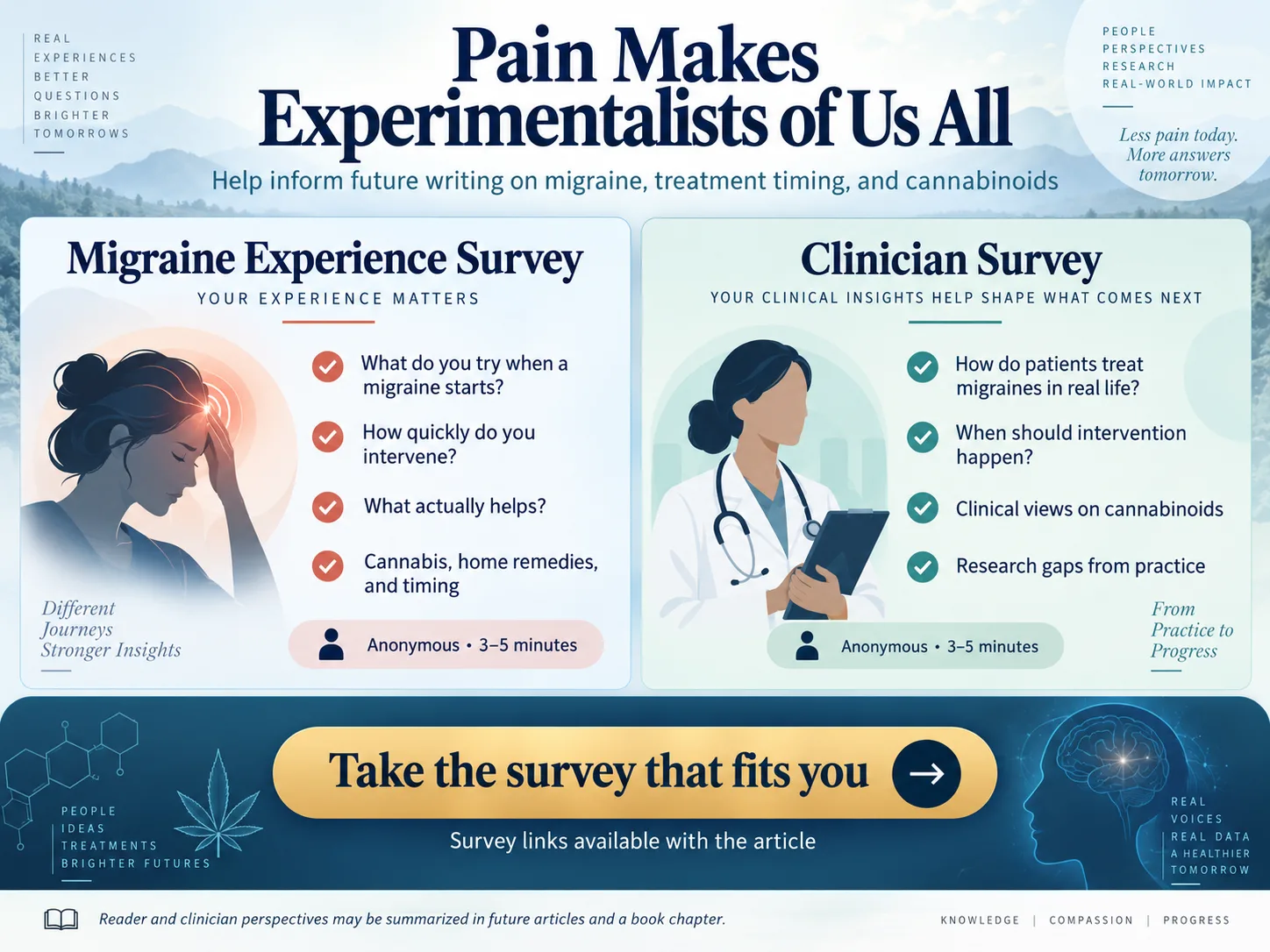
Migraine has a way of turning even careful, evidence-minded people into experimentalists. When an attack begins, people may reach for prescription medications, caffeine, ice packs, acupuncture, cannabis, french fries, mustard, darkness, special light—or whatever has helped before. I’m collecting brief, anonymous experiences to better understand what people actually try, when they try it, and what they believe helps. I’m also collecting a parallel survey from clinicians who treat migraine. Responses may be summarized in future writing, and—with permission—anonymous comments may be quoted in a future article or book chapter.
Migraine Experience Survey CLICK HERE
For Clinicians Migraine Treatment Survey CLICK HERE
Sign up for Text Notifications and get Special Offers and Savings!

© 2026 VALLEY WELLNESS All rights reserved. | Privacy Policy | Terms of Service | Accessibility Statement