
Sometimes late at night, while staring at a large screen and scrolling through fresh cannabis testing data, a certain kind of laboratory meditation takes over. After enough chromatograms, peaks, numbers, and percentages, the boundary between analysis and contemplation begins to blur.
One evening, decided to leave the lab and get some fresh air, in the hope my mind could return refreshed and ready for data review. Walking through a nearby coastal forest, I noticed a faint piney scent wherever I turned. It seemed to come from the trees and surrounding vegetation, mixing with the cool air rolling in from the water.
I felt better breathing it in. There is a certain clarity that comes from a forest, from trees or the sea. Some of that experience may be psychological, but some of it is definitely chemical. The air around plants contains volatile compounds, including terpenes such as pinene. Pinene is one of nature’s aromatic gifts.
The Scent of Pine—and Much More
The two forms most commonly discussed in cannabis are alpha-pinene and beta-pinene. As their names suggest, they are closely associated with the fresh, resinous aroma of pine trees. However, pinenes are not limited to pine forests or cannabis. They occur throughout the plant kingdom and contribute to the aromas of rosemary, basil, sage, conifers, pine nuts, and many other herbs and foods. Pinene can help give pesto its herbal kick and Christmas trees their unmistakable holiday smell.
In cannabis, alpha- and beta-pinene are part of the larger mixture of volatile compounds that gives a flower its particular aroma and character. Not every cannabis or hemp variety contains a meaningful amount, but some contain enough to produce a distinctly fresh, woody, herbal, or forest-like quality.
In samples I have tested, pinene concentrations are often modest—sometimes around 0.5% and occasionally approaching or exceeding 1%. Total terpene concentrations in cannabis flower frequently fall within the low single-digit percentage range, although the exact numbers depend on genetics, cultivation, processing, storage, sampling, and laboratory methodology.
Cannabis Is Not the Only Source
Many terpenes used in cannabis vape products, edibles, fragrances, and formulations are described as botanically derived, meaning they were extracted from plants other than cannabis. This is not necessarily a bad thing. A molecule of alpha-pinene is still alpha-pinene regardless of whether it came from cannabis, pine resin, or another botanical source. What matters is its identity, purity, concentration, and how it is used.
What Does the Research Say?
Pinene has attracted scientific attention because it demonstrates a range of biological activities in laboratory and animal studies. Researchers have reported antimicrobial, insecticidal, gastroprotective, anti-inflammatory, antioxidant, and neuroprotective effects, among others. However, most of this evidence remains preclinical. A biological effect observed in a test tube or mouse should not automatically be interpreted as a proven treatment in humans.
A few interesting areas of research include:
That does not make pinene unimportant. It simply means we should appreciate the molecule without asking the science to say more than it currently can.
What We Lose When We Chase Potency
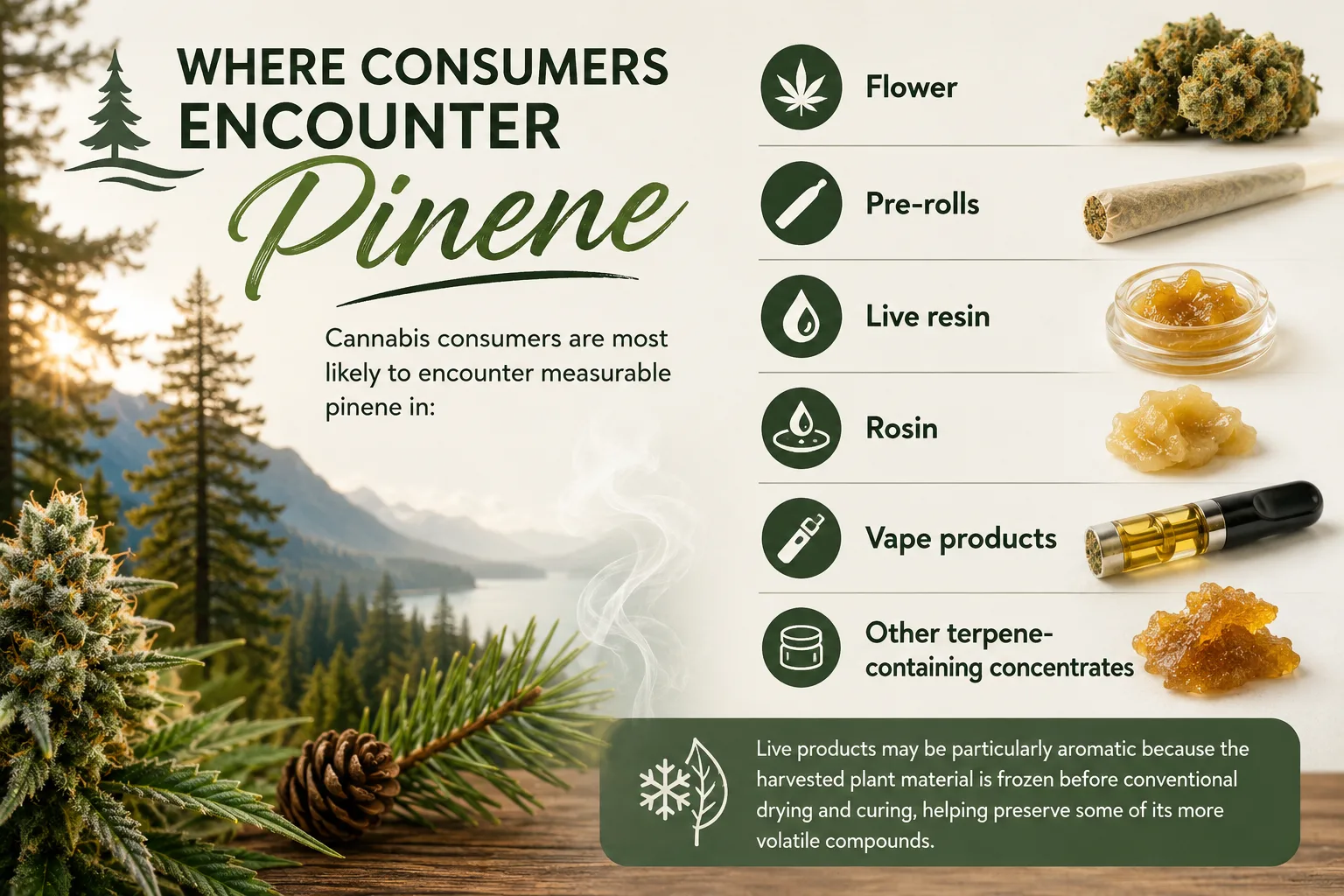
The modern cannabis and hemp market is fixated on potency, especially THCA percentage. In its most extreme form, this creates a dystopian vision of cannabis: dry, flavorless, nearly scentless flower reduced to a single number. Terpenes such as pinene are volatile. They can be lost during harvesting, drying, curing, processing, and storage. The degree of loss depends on the cultivar and the conditions under which the flower is handled. Research increasingly shows that drying conditions should be tailored to the individual plant variety if producers want to preserve its aromatic profile.
Cannabinoid potency is reported as a percentage of weight. Moisture is also part of a flower’s weight, so a drier sample can sometimes produce a higher reported cannabinoid percentage than the same material containing more water—even when the absolute quantity of cannabinoids has not increased. We may gain a fraction of a percentage point while losing the experience that made the flower desirable in the first place. Sometimes we trade complexity for a number, throwing away pinene.
Returning to the Chromatogram
At the end of my walk, I returned to the lab, sat back down in front of the GC-FID, and continued reviewing the data. Soon enough, pinene appeared on the chromatogram, a narrow peak rising like the roof of an A-frame cabin. A small chemical signal from a cannabis sample. A forest molecule found in herbs, foods, laboratories, and industries around the world. Pinene is not a miracle cure, and it does not need to be. Its chemistry, aroma, ecological role, commercial usefulness, and potential biological activity are already remarkable.
Pinene is a gift from nature. We should take care not to evaporate it away.
Sign up for Text Notifications and get Special Offers and Savings!

© 2026 VALLEY WELLNESS All rights reserved. | Privacy Policy | Terms of Service | Accessibility Statement