
Every so often, science produces a paper so beautifully ridiculous that it deserves to be admired like fine performance art. This month’s candidate is “First Detection of Exoplanetary Cannabinoids: Evidence for THC and CBD in the Atmosphere of K2-18b.” Yes, really.
According to the authors, the James Webb Space Telescope detected tetrahydrocannabinol (THC) and cannabidiol (CBD) in the atmosphere of the temperate sub-Neptune K2-18b—a planet 2.6 times Earth’s radius orbiting within the habitable zone of a red dwarf star 124 light-years away. K2-18b is, in fact, a real exoplanet. Astronomers have genuinely studied it for water vapor, methane, and the tantalizing possibility of habitability. It is a serious scientific target. Apparently, it has also been hiding a dispensary.
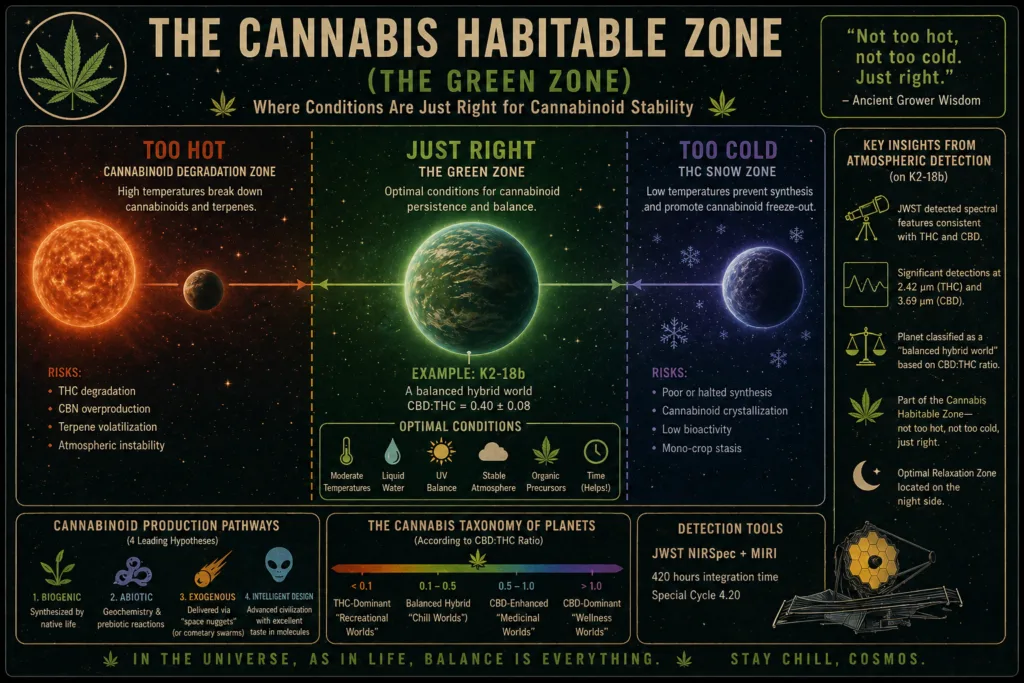
The paper reports, with admirable composure, that “The THC feature at 2.42 µm is detected at 9.2σ significance, while CBD absorption at 3.69 µm reaches 7.8σ.” They further classify the planet as a “balanced hybrid world” based on its atmospheric CBD:THC ratio. Naturally.
The authors introduce the “Cannabis Habitable Zone,” also called the “Green Zone,” where planets are neither too hot for cannabinoid degradation nor too cold for what they describe as “THC snow.” There is even an “Optimal Relaxation Zone” on the night side of the planet. At this point, either modern astronomy has entered a glorious new era, or someone in astrophysics had a deadline and an excellent sense of humor.
Fortunately, the authors eventually confess: “This entire paper is a joke for April Fool’s Day and should not be taken as genuine scientific research.” Darn. For a brief moment, I was genuinely hoping that Blaise P. Hasheau, Mary Jane van der Pot, and Bonnie McToke were real scientists who had somehow wandered, gloriously and against all institutional odds, into weed science. One imagines them moving through faculty meetings with perfect seriousness, publishing papers between conference coffee breaks and suspiciously well-timed lunch walks.
The fictional “Dank-HITRAN” molecular database was perhaps another clue. The listed institutions—such as the Coffeeshop Institute for Atmospheric Research and the Max-Planck-Institut für Entspannungsforschung (Institute for Relaxation Research)—were also subtle hints, though admittedly less subtle after the third reread, somewhere around the mention of “Special Cycle 4.20” and the discovery of a planet classified as a “balanced hybrid world.”
And yet, here is the interesting part: the joke works.
It works because cannabinoids are not chemically absurd. They are not magical plant inventions or botanical contraband smuggled into biology. They are ordinary organic molecules built from familiar architecture—carbon rings, oxygen-containing functional groups, lipid precursors, terpene pathways, and enzyme-driven modifications. They emerge from chemistry that nature seems to enjoy repeating. Nature, after all, is a shameless plagiarist.
The deeper lesson is not about THC in alien skies. It is about scientific plausibility. People often imagine cannabinoids as exotic, controversial, somehow separate from “normal” biology—as though THC arrived from another dimension wearing sunglasses and asking for snacks. But the endocannabinoid system is ancient biology. It is a homeostatic language, concerned with balance, feedback, appetite, pain modulation, immune signaling, stress response, and the perpetual bureaucratic work of keeping an organism from falling apart.
Which raises the more interesting question: if life elsewhere solves the same problems—stress, injury, inflammation, reproduction, survival—using similar biochemical logic, might it also evolve molecules functionally analogous to endocannabinoids? Not THC. Not CBD. But perhaps molecular cousins. Different names, different structures, the same biochemical conversation.
We should not expect alien planets to smell like a dispensary. But we should not assume that receptor-active lipid signaling molecules are uniquely terrestrial, either. Life tends to favor elegant solutions, and chemistry is often conservative in its creativity. The endocannabinoid system, in that sense, may be less a botanical curiosity and more a universal principle: life negotiating constantly between chaos and equilibrium. That part may be cosmic.
If we ever did genuinely detect cannabinoids in an exoplanet’s atmosphere, I would have a few immediate questions. First: what else have we been missing in atmospheric detection? If a telescope can confidently distinguish THC at 124 light-years, then the future of spectroscopy is either far more sophisticated than most people realize, or several graduate students deserve Nobel Prizes and a very long vacation.
Second: what exactly is floating around in our own atmosphere? We already know volatile organic compounds, terpenes, aerosols, and all manner of chemically interesting things move through the air around us. Not cannabinoids in any meaningful planetary sense, of course—but the question reminds us that atmospheric chemistry is less empty sky and more invisible soup, a molecular gossip column circulating above our heads.
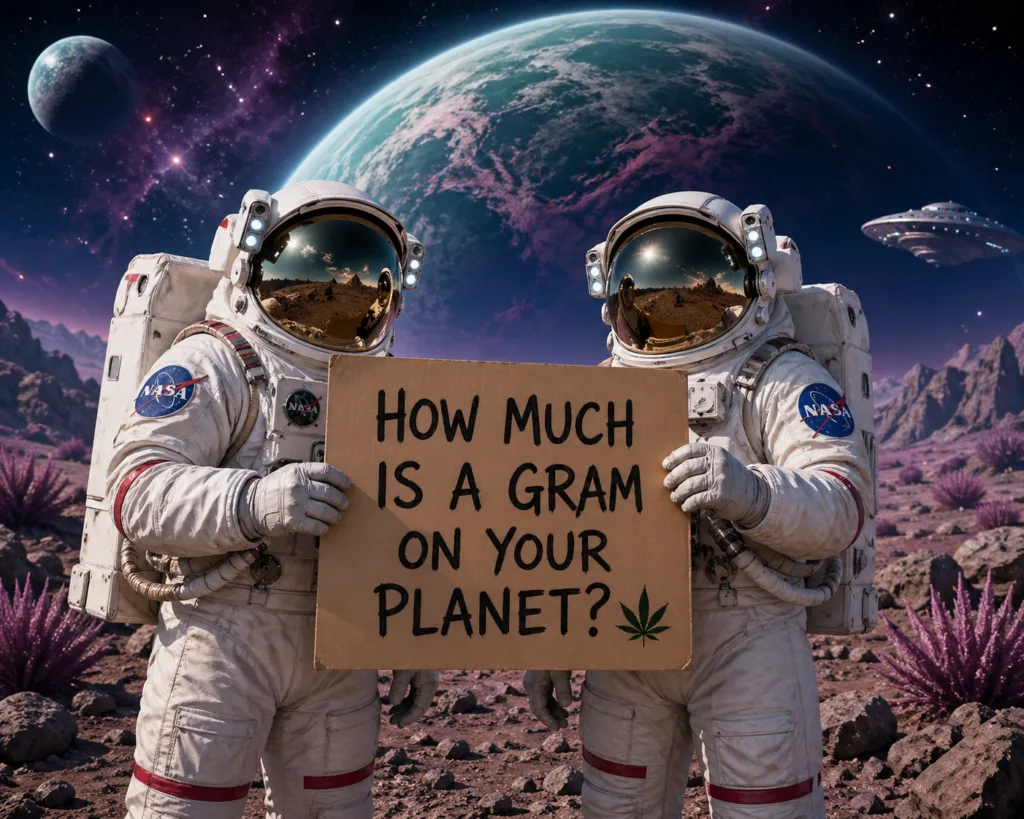
And third—perhaps most importantly—how much is a gram on K2-18b?
At 8.6 times Earth’s mass and 2.6 times its radius, gravity calculations suggest your average dispensary visit would feel significantly heavier. Whether this affects pricing, consumer behavior, or interplanetary loyalty programs remains tragically underexplored. Two serious questions, and one essential one. Science, like good cannabis policy, should always leave room for both skepticism and proper prioritization.
And if somewhere on K2-18b there is an alien biochemist quietly studying receptor agonists under a violet sky—making discoveries that would revolutionize our understanding of biology while wondering why humans keep naming everything after Greek gods—well, that would be pretty chill.
Sign up for Text Notifications and get Special Offers and Savings!

© 2026 VALLEY WELLNESS All rights reserved. | Privacy Policy | Terms of Service | Accessibility Statement