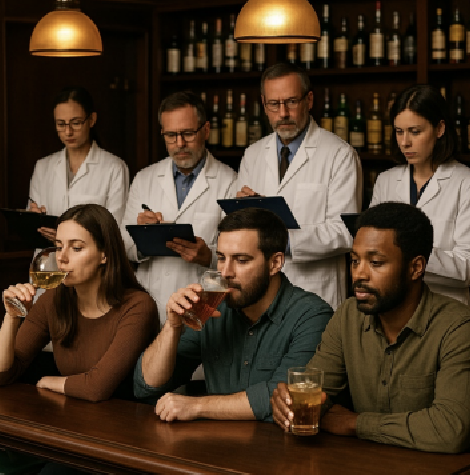
There are few sights more American than a cold drink in the hand at the end of a long day. And until recently, that drink was almost always alcoholic. But history, like biology, does not move in straight lines. It loops, adapts, compensates—and sometimes substitutes. As cannabis legalization expands and THC-products multiply like caffeinated rabbits, a new cultural experiment is underway: can cannabis replace alcohol, or at least soften its gravitational pull?
A major 2025 randomized controlled trial published in the American Journal of Psychiatry offers one of the clearest experimental answers yet. The results are quietly provocative—and far more nuanced than social media slogans about being “California sober” would suggest.
For years, researchers have watched cannabis and alcohol circle each other epidemiologically—sometimes as companions, sometimes as rivals. Observational studies have shown everything from increased heavy drinking among co-users to reductions in alcohol intake on cannabis-use days. Both sides could claim data. Neither side had causality.
This new study finally asks the question in a controlled way: what actually happens when THC enters the body before alcohol is available?
Not in a bar.
Not in a survey.
But in a laboratory where behavior, blood chemistry, heart rate, and consumption are measured minute by minute.
Researchers recruited 138 adults who were both frequent cannabis users and heavy drinkers. Across three separate sessions, participants smoked:
- A placebo cigarette (0.03% THC)
- A low-dose active cigarette (3.1% THC)
- A moderate-dose active cigarette (7.2% THC)
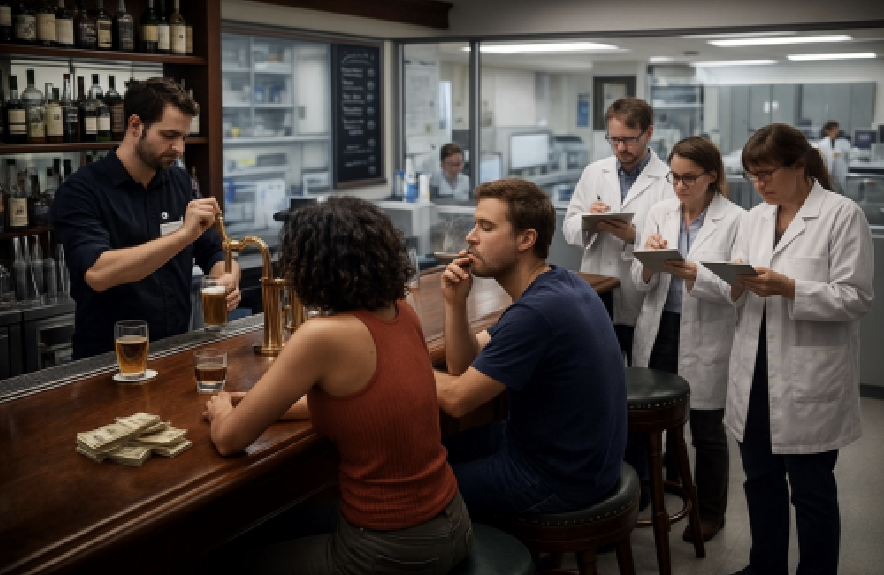
Cannabis intake was controlled; the participants followed a standardized “paced puffing procedure,” listening to an audio tape instructing them when to inhale and exhale. After smoking, participants were exposed to alcohol cues—sights, smells, personalized triggers—and then entered a two-hour alcohol choice task in a lab designed to look like a bar. They could either drink alcohol or receive money instead (three dollars per drink). Their craving, urge, heart rate, intoxication, and blood THC levels were carefully tracked the entire time.
“This is basically a very carefully, precisely designed study of cross-fading,” said Dr. James MacKillop, the director of the Michael G. DeGroote Center for Medicinal Cannabis Research at McMaster University and an author on the study, told the New York Times. (Cross-fading means getting simultaneously drunk and high.)
This is about as clean a behavioral pharmacology design as one can achieve without putting people inside a particle accelerator.
The headline result is disarmingly simple:
After smoking THC, participants drank significantly less alcohol.
Specifically:
- 3.1% THC reduced alcohol consumption by ~19%
- 7.2% THC reduced alcohol consumption by ~27%
- The higher dose also delayed the first drink by nearly 50%
Let that sink in. Under blinded, controlled conditions, THC did not increase drinking—it suppressed it. Yet craving told a subtler story. On standard multi-item craving scales, THC did not dramatically alter alcohol craving. On a simpler “urge” question, the higher THC dose briefly lowered desire. Translation: people still wanted alcohol—but they drank less of it.
THC stimulates the brain’s endocannabinoid system (ECS), a sprawling regulatory network intertwined with dopamine, reward prediction, and incentive salience—the neurological machinery of “wanting.” In regular, frequent cannabis users, CB1 receptors are thought to drift into a state of functional downregulation, a polite neurochemical way of saying the brain adapts. Over time, the body begins to treat THC less like a surprise guest, and more like that outdoor, feral cat that wandered into your house one afternoon and never left. At first it knocks things over. Eventually you move the furniture to accommodate it. The brain calls this adaptation; the cat calls it home. A brief period of abstinence followed by renewed THC exposure, however, may temporarily scramble the reward circuitry and reshuffle the deck.
The researchers also float another explanation—one that is elegant, economical, and just a little mischievous:
People may be titrating intoxication across substances, not chasing alcohol specifically.
In plain language, once THC takes the edge off the brain’s appetite for altered states, alcohol becomes less urgent. If alcohol is a grand banquet for the brain’s reward system, THC is the pizza and nachos—easy and always satisfying. You still want to go to the banquet—but after pizza, perhaps you’ll go another day.
Here is where the cultural narrative runs ahead of the data. The phrase “cannabis as a safer substitute for alcohol” is racing faster than the science can responsibly follow. “I’d hate to see these findings interpreted as getting intoxicated on cannabis is better than getting intoxicated on alcohol,” said George Singletary, MD, an assistant professor of addiction medicine at the Tulane University School of Medicine.
The same study that showed reduced alcohol intake also issued a formal caution:
It would be premature—and potentially risky—to recommend cannabis as a sole harm-reduction strategy for alcohol use disorder.
Why? Because:
- Participants still drank alcohol while intoxicated with THC
- Most were near-daily cannabis users, not occasional consumers
- Long-term substitution patterns remain unknown
- Risks associated with cannabis use disorder remain somewhat unpredictable
History teaches us that every “solution” to intoxication eventually becomes its own sociological problem.
“Cannabis can reduce drinking in the short term, but it also carries its own risks. Our study is a first step, and we need more long-term research before drawing conclusions for public health,” said Jane Metrik, PhD, a professor of Behavioral and Social Sciences and Psychiatry at Brown University, and first author of the study.
The brain does not moralize. It budgets. It allocates neurotransmitters the way a finance committee allocates funding—never enough for everything, always enough for trouble. This study suggests the brain negotiates between THC and ethanol in real time, adjusting total reward rather than defending loyalty to a single molecule. That insight matters for clinicians, patients, and policymakers who still think in siloed categories: alcohol dependence, cannabis dependence, poly-substance use. The brain sees none of those. It sees chemistry and context.
From a consumer and healthcare perspective, three grounded conclusions emerge:
- THC may reduce alcohol consumption in the short term—but not alcohol use itself.
- Craving is not the same as consumption.
- Substitution is pharmacologically plausible—but clinically unproven as a treatment strategy.
For patients who already report replacing some alcohol with cannabis, clinicians should:
- Monitor both substances, not just one
- Screen for cannabis use disorder
- Emphasize evidence-based alcohol therapies alongside any adjunctive cannabis use
Harm reduction is not a slogan. It is a slow, data-driven negotiation with biology.
The study also lands squarely in the center of a fast-moving wellness trend: cannabis as the civilized alternative to alcohol. THC drinks now sit beside seltzers in refrigerated cases, marketed with the rhetoric of moderation, balance, and botanical restraint.
Science, as usual, offers neither redemption nor condemnation—only constraints.
Yes, THC reduced drinking in this lab.
No, that does not mean it reduces harm in the wild.
Yes, the brain substituted one reward for another.
No, it did not abolish the desire for reward itself.
“At the end of the day, it will have to be these really tightly controlled laboratory studies and then the real-world evidence coming together to paint the picture,” said Dr. Johannes Thrul to the New York Times, an associate professor at the Johns Hopkins Bloomberg School of Public Health. “Because none of these studies can answer these questions by themselves.”
You can move desire from one vessel to another.
You can dilute it.
You can delay it.
But you rarely erase it.
This study gives us one of the cleanest demonstrations yet of how delicately the brain balances chemical want. THC, at specific doses, altered that balance just enough to soften alcohol’s grip—without snapping the chain of craving altogether.
The message is neither prohibition nor celebration. It is precision. Thoughtful dosing. Careful context. Continuous monitoring. And above all, humility in the face of a nervous system that has been negotiating intoxication far longer than we have been regulating it.