Scientists Resurrect Ancient Cannabis Genes
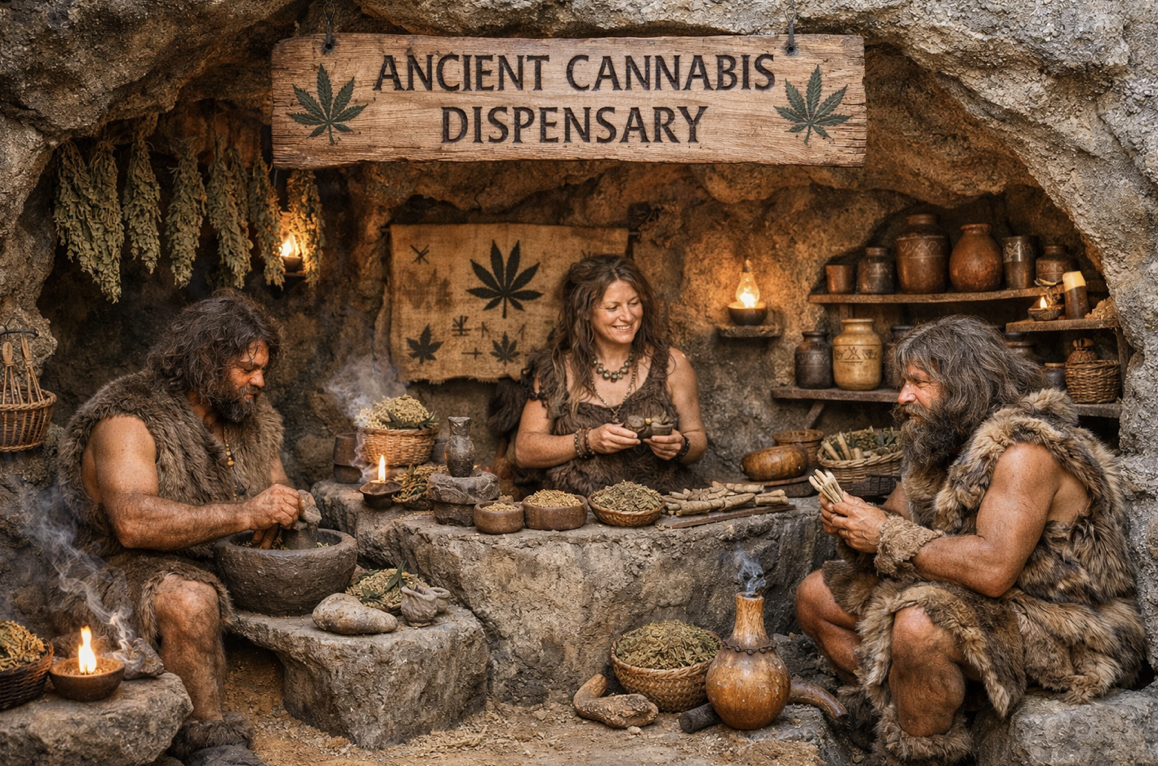
People have been consuming Cannabis for a very long time. Humans were already experimenting with this plant in surprisingly creative ways long before dispensary menus, lab certificates, or debates about THC percentages. Archaeologists have uncovered evidence of Cannabis used in burial rituals, smoked out of gourds and through hollowed-out bones, heated on stones inside tents, and even inhaled through makeshift “bongs” carved into the ground.
Cannabis appears loudly across many ancient cultures. In India, the plant and its products were associated with sacred rites and festivals. In China, it was cataloged as medicine thousands of years ago. In Egypt, it appeared in medical papyri. In Jewish tradition and texts, Cannabis is not explicitly named but Kaneh Bosem is described as an aromatic resinous reed plant, a fragrant cane. Many societies wrote about it directly. Others folded it into medicine, incense, or ritual practice without fanfare. Curiously, the Romans—otherwise meticulous record keepers—are relatively quiet on the subject.
All of which raises a simple but oddly unanswered question:
What was Cannabis actually like when humans first encountered it?
Was it THC-heavy? Was it CBD-rich, as is often claimed? Or was ancient Cannabis something else entirely? Did it smell the same? Recent genetic research suggests a far more interesting answer: early Cannabis wasn’t chemically extreme. It was chemically flexible.
Magic, Medicine, and the Material Medica
Historically, Cannabis didn’t live in tidy categories like recreational versus medical. It lived among the material medicas. These ancient documents are guides for collections of plants, resins, roots, and minerals used for healing, ritual, and meaning-making.
Ancient sources describe uses of the plant as:
- a treatment for pain, digestion, and inflammation
- a sacred or ceremonial plant
- a facilitator of altered states tied to prayer, storytelling, or ritual
Scholars have long debated whether certain aromatic reeds and sacred oils referenced specific psychoactive plants. The point isn’t to rewrite scripture or settle theological debates. It’s to recognize something more basic: plants, medicine, and meaning were once inseparable. Healing was both physical and spiritual, and Cannabis has sat comfortably in that overlap throughout history.
But Was Ancient Cannabis Different?
Here’s where modern science adds a plot twist. For years, people have confidently claimed that ancient Cannabis was “mostly CBD” or “much weaker” than today’s plants. These ideas sound plausible but until recently, they were mostly speculation. Cannabinoids don’t appear by magic. They are made by enzymes in trichomes. These are highly specialized proteins inside the plant. These enzymes take precursor molecules and make cannabigerolic acid (CBGA), then convert it into the cannabinoids we recognize today: THCA, CBDA, and CBCA.
Modern plants rely on enzymes that are extremely picky, bred for efficiency and predictability. One enzyme produces THC. Another produces CBD. Another produces CBC. One enzyme, one outcome. Engineered to produce the target drug at all costs, hence THC-plants.
But scientists at Wageningen University did something unusual. Instead of studying modern Cannabis enzymes, they reconstructed ancient ones—resurrected versions inferred from genetic data and expressed in the lab. These ancestral enzymes likely existed millions of years ago, long before humans cultivated or selectively bred specific varieites.
What they found upends the popular narrative. Early enzymes were not picky. They converted CBGA into multiple cannabinoids at once—rather than favoring a single product. In evolutionary terms, Cannabis didn’t start as “THC-type” or “CBD-type.” It started as promiscuous, a rich blend of compounds. As cannabinoid synthases became more specialized, they often became less robust. The ancestral enzymes were:
- more flexible
- easier to express in lab systems
- more tolerant of environmental conditions
An author of the ancient enzyme research, Robin van Velzen stated, “What once seemed evolutionarily ‘unfinished’ turns out to be highly useful.”
Evolution didn’t optimize the plant for medicinal, spiritual, or recreational use. Humans did it by narrowing its possibilities.
So… Was Ancient Cannabis CBD-Rich?
Probably not in the way people imagine. The ancestral enzymes produced mixed cannabinoid profiles, with THCA likely emerging as a dominant product—but alongside CBDA, CBCA, and other compounds. The clean THC-versus-CBD divide appears to be a later development, driven by gene duplication, mutation, separation of plant populations (such as on either side of the Kush mountains) and eventually by human breeding priorities.
In other words, the Cannabis encountered by early humans (hunter-gatherers tracking animals across open landscapes) was likely broader, softer, and more chemically diverse than most modern cultivars.
Not weaker. Just different. A little more random. A whole plant product.
CBC: A Forgotten Ancestral Cannabinoid
One of the most intriguing findings from this research involves CBCA, the acidic precursor to cannabichromene (CBC). CBC is often labeled a “minor cannabinoid.” But genetically speaking, it may be anything but minor. The resurrected ancestral enzymes consistently produced CBCA, sometimes preferentially—suggesting that CBC may have been one of the plant’s earliest companions. As study co-author Robin van Velzen explains:
“At present, there is no cannabis plant with a naturally high CBC content. Introducing this enzyme into a cannabis plant could therefore lead to innovative medicinal varieties.”
That single sentence quietly challenges decades of breeding priorities. CBC may not be an afterthought. It may be a throwback.
From Sacred Smoke to Sequencing DNA
So what were the ancients smoking? They were probably not using today’s 30% THC flower for recreation. Probably not using CBD isolate for medical uses either. Probably not using derived or synthetic cannabinoids for divination.
They likely encountered a broader, gentler, more complex Cannabis. One shaped by mixed cannabinoids, ritual context, and intention rather than potency chasing. A plant that blurred the lines between medicine, ceremony, and curiosity about the unseen.
Modern genetics doesn’t demystify that history. It deepens it. What we’re learning now is that Cannabis didn’t evolve to be extreme. Humans trained it that way. And in rediscovering its ancient chemistry, science is quietly circling back to what early cultures may have understood intuitively. Cannabis was never just a drug. It was a relationship with plants, bodies, stories, and meaning.