
Surveys, “hits,” and the strange science of predicting marijuana use
Ask someone how much cannabis they use and you may receive an answer that sounds precise, but dissolves under pressure. You might here responses such as, “A little…on most nights…just a few hits…one gummy…half a joint…perhaps A bowl…a cart every couple of weeks.” And the occasional, “It depends.”
And of course, it does depend. It depends on the product, the potency, the person, the setting, the tolerance, the mood, the price, the social context, the size of the joint, the honesty of the label, the accuracy of memory, and whether the consumer is describing what they actually did, what they usually do, what they think they do, or what they are comfortable admitting.
This is why cannabis surveys can be both useful and maddening. They are often the best tool available for understanding patterns of use across populations. They are also vulnerable to the ancient human tendency to be unreliable narrators of our own lives. We forget and misremember, sometimes we round up or down. Some of us underreport, others exaggerate. We translate lived behavior into awkward categories designed by people with spreadsheets.
So, when a new study asks whether people’s stated cannabis demand corresponds to actual laboratory cannabis use, it lands in an interesting place: somewhere between behavioral science and a comedy sketch about academics trying to describe a smoke session.
The study, published in Addiction, is titled “Is toke cheap? Correspondence between cannabis demand and purchase in the laboratory.” The question is simple enough: when people say how much cannabis they would use at different prices, does that tell us anything meaningful about what they will actually do when cannabis is available?
The “hit” as a unit of science
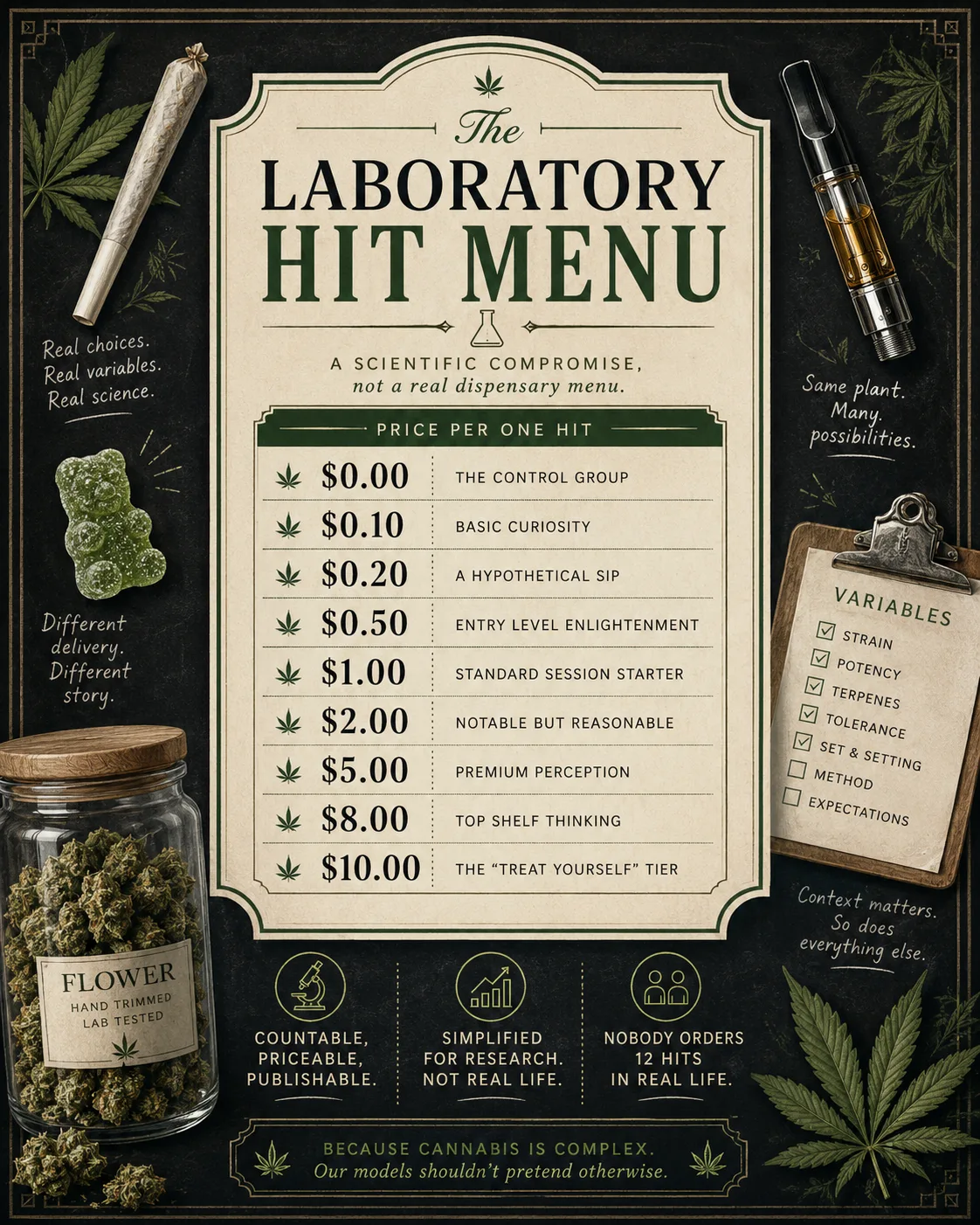
The researchers used something called a Marijuana Purchase Task (MPT). Participants were asked how many “hits” of cannabis they would buy or consume at different prices. They completed a hypothetical version and then an “actual” version, where one of their choices was randomly selected and turned into a real laboratory smoking opportunity.
This is where the study becomes both clever and awkward, and has the potential to become the next marketing gimmick.
Participants reached into a bowl containing a poker chip. Each poker chip corresponded to the price of one of the MPT items. For example, you might draw a chip that corresponds to, “How many hits of marijuana would you smoke if they were $1 each? Prices ranged from $0 to $10 per hit.
Blood pressure and heart rate were continuously assessed during the entire experimental session for safety monitoring. Participants were then permitted to purchase and smoke cannabis hits ad libitum during the session using a modified controlled paced-puffing procedure (48,50). They were instructed to raise their hand to indicate they wished to order a cannabis hit. The price of the hit was subsequently deducted from their budget. Research staff then initiated a recording instructing the participant to “light the cigarette,” “get ready” (5s), “inhale” (5s), “hold smoke in lungs” (10s), and “exhale.” This modified paced puffing procedure was implemented to best control the duration of each hit across participants. This procedure was repeated until the participant reached the number of cannabis hits available to smoke or chose to cease smoking. At the end of the 1-hour cannabis administration period, participants received any remaining money from the budget that was not used to purchase cannabis (e.g., budget = $20, item selected from Actual MPT = $5/hit, participant reported they would purchase 3 hits at this price, 3 units were available during the smoking procedure, 2 of the 3 available hits were smoked, participant subsequently received the remaining $10 from the budget).
A “hit” is a convenient laboratory unit. It is countable. It can be priced. It can be administered in a controlled way. Scientists like countable things because countable things can be graphed, modeled, compared, and published.
But cannabis consumers do not really live in a world of cleanly priced hits of pulverized government weed. They buy pre-rolls, vape cartridges, gummies, beverages, tinctures, concentrates, infused chocolates, rosin, resin, and products with names that sound like either tropical vacations or minor crimes. They make decisions based on price, potency, brand, familiarity, smell, budtender advice, discount menus, taxes, tolerance, and sometimes vibes.
Nobody walks into a dispensary and says, “I’ll take twelve hits, please.”
That does not make the study useless. It makes it a laboratory translation of a real-world behavior. The “hit” is less a marketplace unit than a scientific compromise.
The researchers acknowledge this limitation. Prior work has suggested that grams may be a better unit for assessing cannabis demand, but grams are not especially practical when the goal is to observe cannabis smoking during a one-hour laboratory session. In other words, the study had to choose between real-world messiness and experimental control. It chose control.
What the study found
The study enrolled regular cannabis users and asked them to report how much cannabis they would consume at escalating prices. Then, in the laboratory, participants had the opportunity to smoke cannabis based on one of their own purchase-task responses.
The results were surprisingly strong. People’s hypothetical and actual cannabis purchase-task responses were highly correlated. More importantly, the amount of cannabis people said they would consume under the actual purchase condition strongly predicted how much they later smoked in the lab.
On average, participants smoked about 84% of the cannabis made available to them. The number of hits made available based on their own stated preference explained a substantial amount of the variation in actual smoking behavior.
In plain English: when people were asked a structured question about immediate cannabis demand, their answers were not just noise. Under controlled conditions, those answers predicted behavior. This is the useful part of the study. It suggests that some forms of cannabis self-report may have real predictive value, especially when they are specific, structured, and tied to a realistic immediate choice.
But this is not the same as saying, “Cannabis surveys are reliable.” That would be too easy.
What consumers can take from this
For consumers, the practical lesson is not that you need to start calculating your cannabis demand curve before visiting a dispensary.
Please do not stand at the counter muttering, “My elasticity appears to increase above $4 per hit.”
The lesson is simpler: cannabis behavior is often more predictable than it feels, but only when we ask better questions.
The bottom line
This study does not prove that cannabis users always accurately report what they do. It does not prove that ordinary surveys can reliably capture cannabis exposure. It does not prove that asking about “hits” reflects how people buy cannabis in real life.
But it does show something important. When cannabis users are asked structured questions about immediate consumption under specific price conditions, their answers can meaningfully predict what they later do in a controlled setting.
For cannabis consumers, clinicians, and policymakers, that may be the larger lesson. We should be cautious about taking every survey answer at face value, but we should not dismiss self-report altogether. People may not always know exactly how much cannabis they used last month. But under the right conditions, they may reveal something very important about how they make choices.
Sign up for Text Notifications and get Special Offers and Savings!

© 2026 VALLEY WELLNESS All rights reserved. | Privacy Policy | Terms of Service | Accessibility Statement